Reading the Season: One of Our Driest Winters Yet
Across the Western Cape, rainfall is an important part of the winter, to replenish water in the landscape before the warmer months arrive. This year, one part of that story has been particularly noticeable: how little rain has fallen throughthe winter months. By the end of August, our vineyard had received the lowest amount of rainfall in our 12-season record. Looking at our own historical weather records at Waterford Estate, located in Stellenbosch, we can see just how dry this winter has been.
What the Data Shows
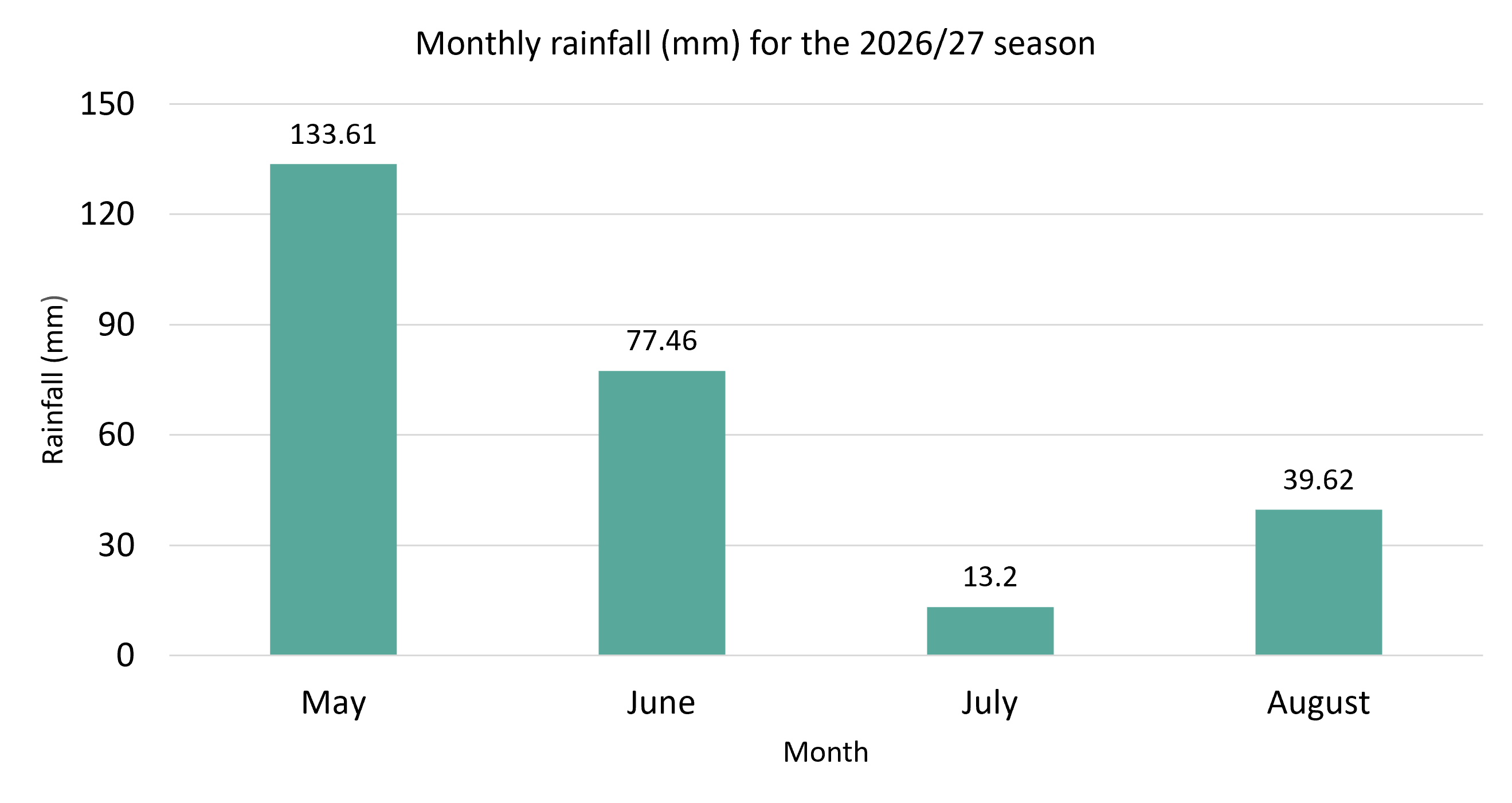
At the start of the season, we received a good amount of rain in May, followed by some rainfall in June. However, July and August have been notably dry with only 13.2 mm and 39.62 mm respectively, Figure 1.
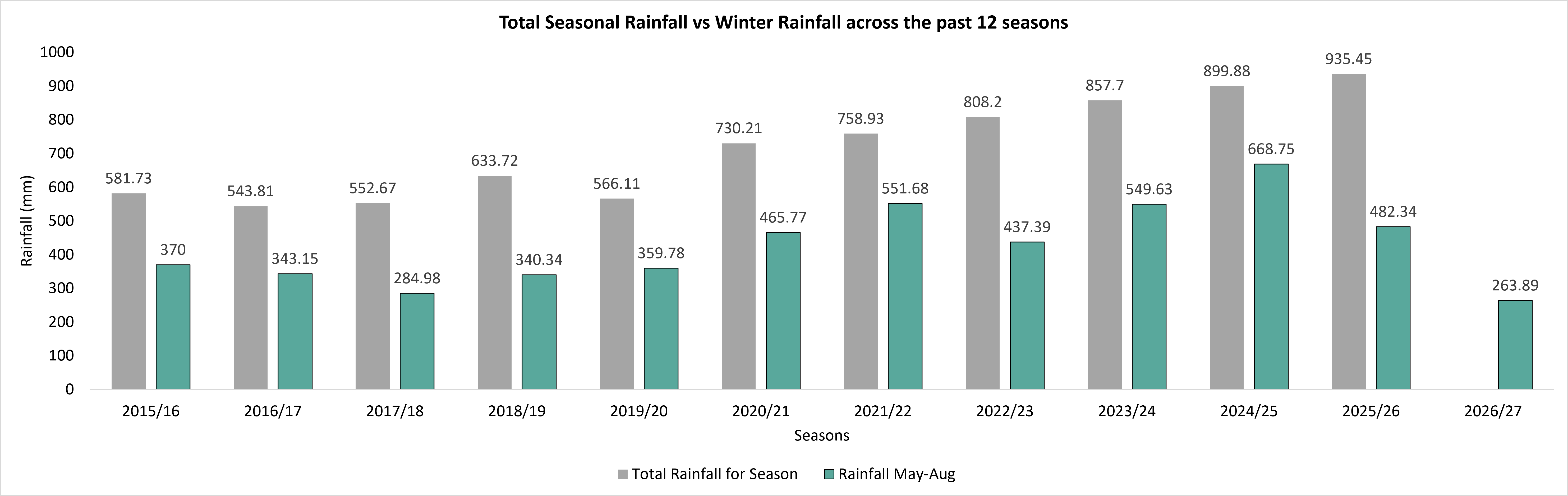
When we look at the rainfall from May to August across the past 12 seasons, this season clearly stands out as one of the driest for this period with only 263.89 mm of rain for May to August, Figure 2. The closest comparison is the 2017/18 season, when 284 mm was recorded over the same period during a year also marked by drought conditions. When we look at rainfall for the remainder of the season across the past 11 seasons, we see that 2016/17 and 2017/18 were among the drier seasons overall. In both seasons, the rainfall that followed the dry winter months were still 22 - 24 % below the total seasonal average of 715.31 mm. So, could this season be heading in a similar direction to 2016/17 and 2017/18, when rainfall remained below average during spring and summer?
Why does timing matter?
What we do know is that, in a Mediterranean climate with hot, dry summers, winter rainfall is crucial for replenishing water reserves before the growing season (Myburgh, 2018). In the Coastal regions, specifically Stellenbosch, historical data show that about 65% of the annual rainfall typically occurs during autumn and winter. Furthermore, the grapevines in these regions have adapted to the seasonal rhythm, where wet winters are followed by hot summers, and their growth is timed accordingly. But rainfall is not the only part of the winter story.
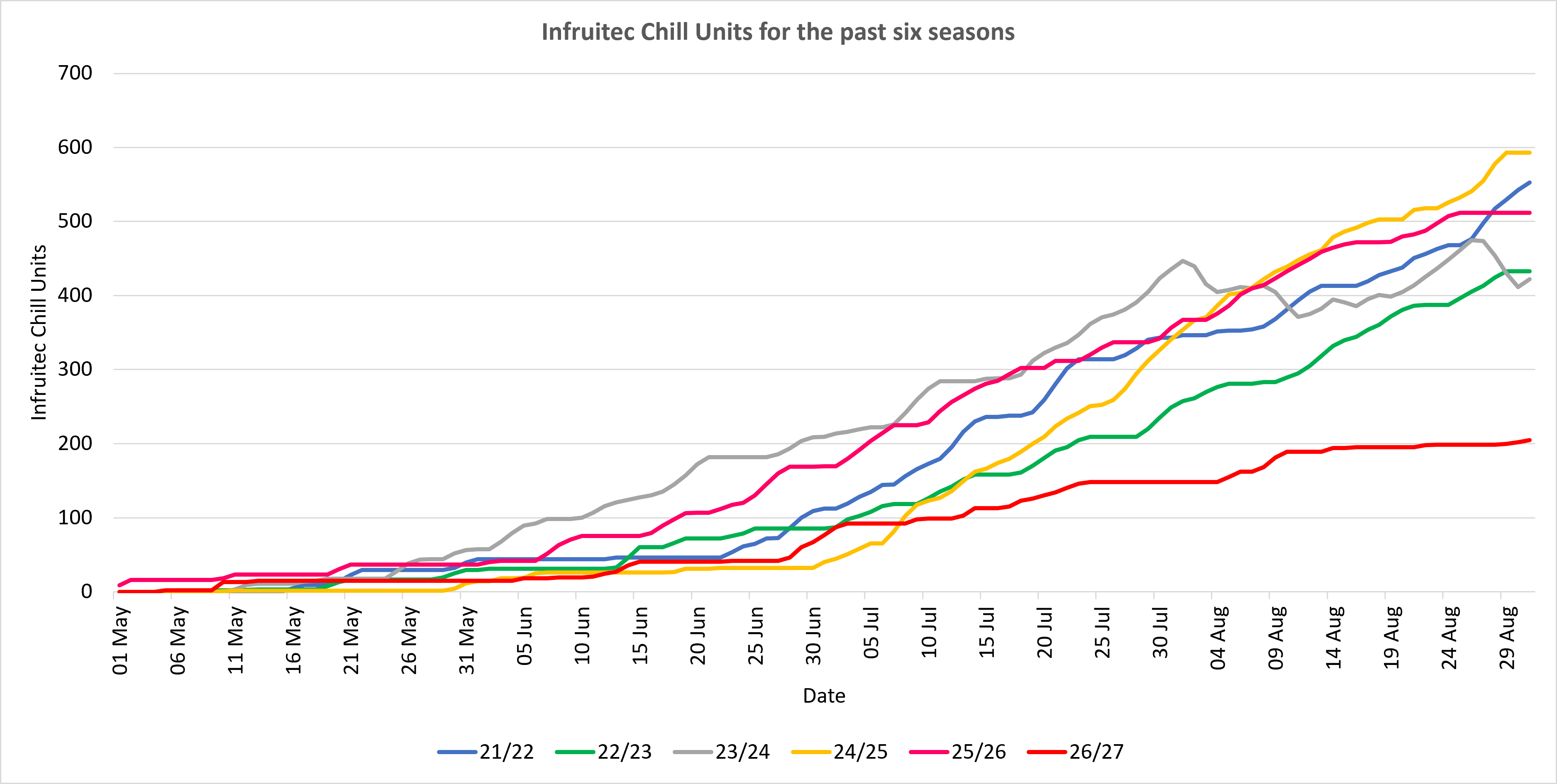
This season, our chill accumulation has remained unusually low into August. Infruitec Chill Units provide an estimate of effective winter chilling based on the temperatures recorded through the winter, with different temperatures contributing differently to the overall accumulation. This season has accumulated substantially fewer Infruitec Chill Units than the previous five seasons. By the end of August only 205 chill units accumulated compared to around 420 and 500 units in the previous five seasons, Figure 3. This matters because winter temperatures contribute to the progression of grapevine dormancy and influence the timing and uniformity of budbreak. Insufficient chill accumulation can therefore influence when and how uniformly budbreak occurs, with potential effects further in the season, including flowering and yield (Londo & Johnson, 2014). We are already seeing early budbreak in some cultivars, earlier than expected. Additionally, we have also observed slower cover crop growth this season, coinciding with the combination of limited rainfall and unusual winter temperatures.
So, what happens next?
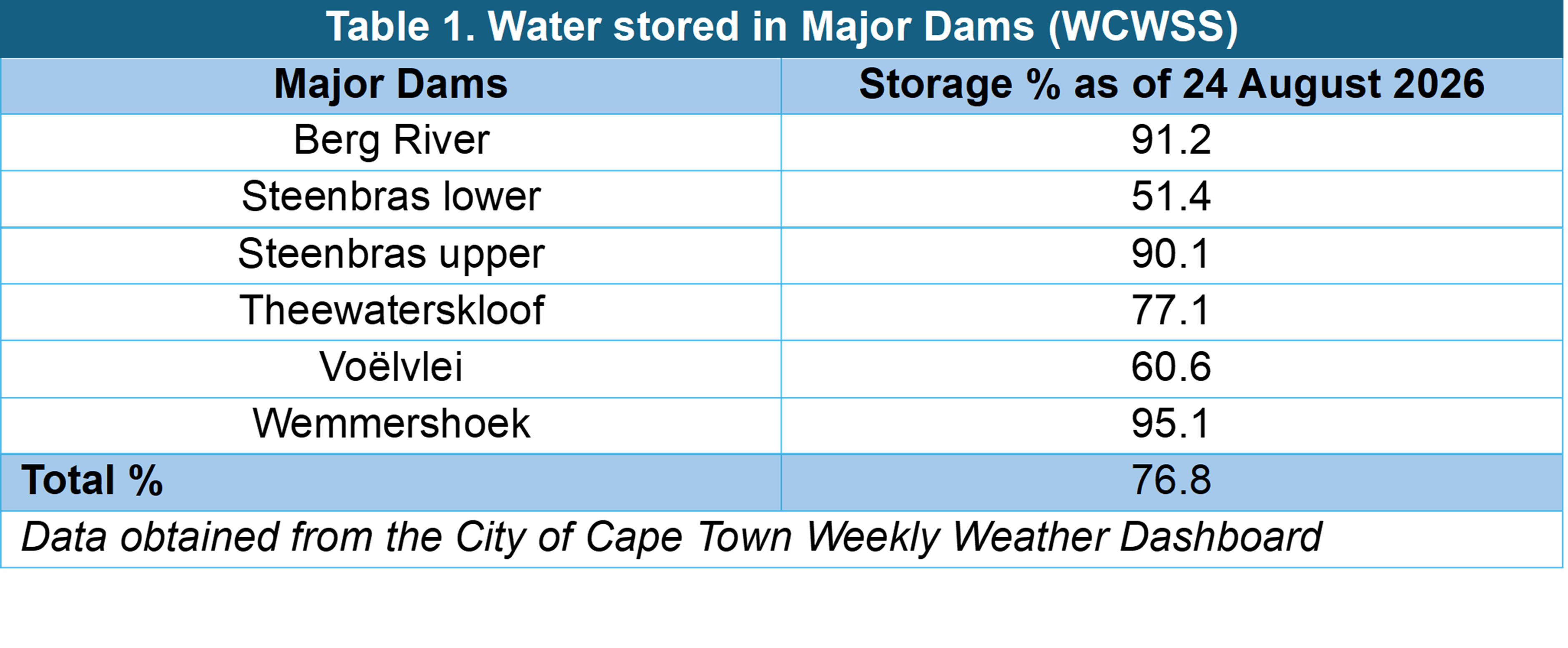
For growers, the focus now shifts to managing the season ahead. Knowing how low the winter rainfall has been, prioritizing irrigation and monitoring soil moisture will be important as vines move into active growth. Fortunately, as of 24 August the six major dams of the Western Cape Water Supply System (WCWSS) were at 76.8 % (City of Cape Town, 2026; Department of Water and Sanitation, 2026), see Table 1. However, we should not turn a blind eye to the possibility that this season could follow a pattern similar to 2016/17 and 2017/18, when below average rainfall persisted into the remainder of the season. The City of Cape Town already issued an early drought caution as the dam levels have been increasing slower than expected (City of Cape Town, 2026). Despite the early caution, the current dam levels provide some reassurance as we move into the season.
While water availability will be important in the months ahead, the vines are already giving us another indication that this season is different through the early budbreak observed, raising the possibility of an earlier season. Whether this translates into a dry vintage or simply an unusual start to the season remains to be seen. For now, our focus is on watching the vineyard closely. We will continue to monitor weather conditions to ensure vines have sufficient water as the season progresses, while closely tracking phenological stages to see how this winter translates into vine development.
References
City of Cape Town, 2026. City of Cape Town Weekly Water Dashboard. [Online]
Available at: https://www.capetown.gov.za/
Department of Water and Sanitation, 2026. Western Cape Government. [Online]
Available at: https://www.westerncape.gov.za/latest-western-cape-dam-levels
Londo, J. P. & Johnson, L. M., 2014. Variation in the chilling requirement and budburst rate of wild Vitis species. Environmental and Experimental Botany, Volume 106, pp. 138-147.
Myburgh, P., 2018. Handbook for irrigation of wine grapes in South Africa. 1 st ed. s.l.:s.n.